
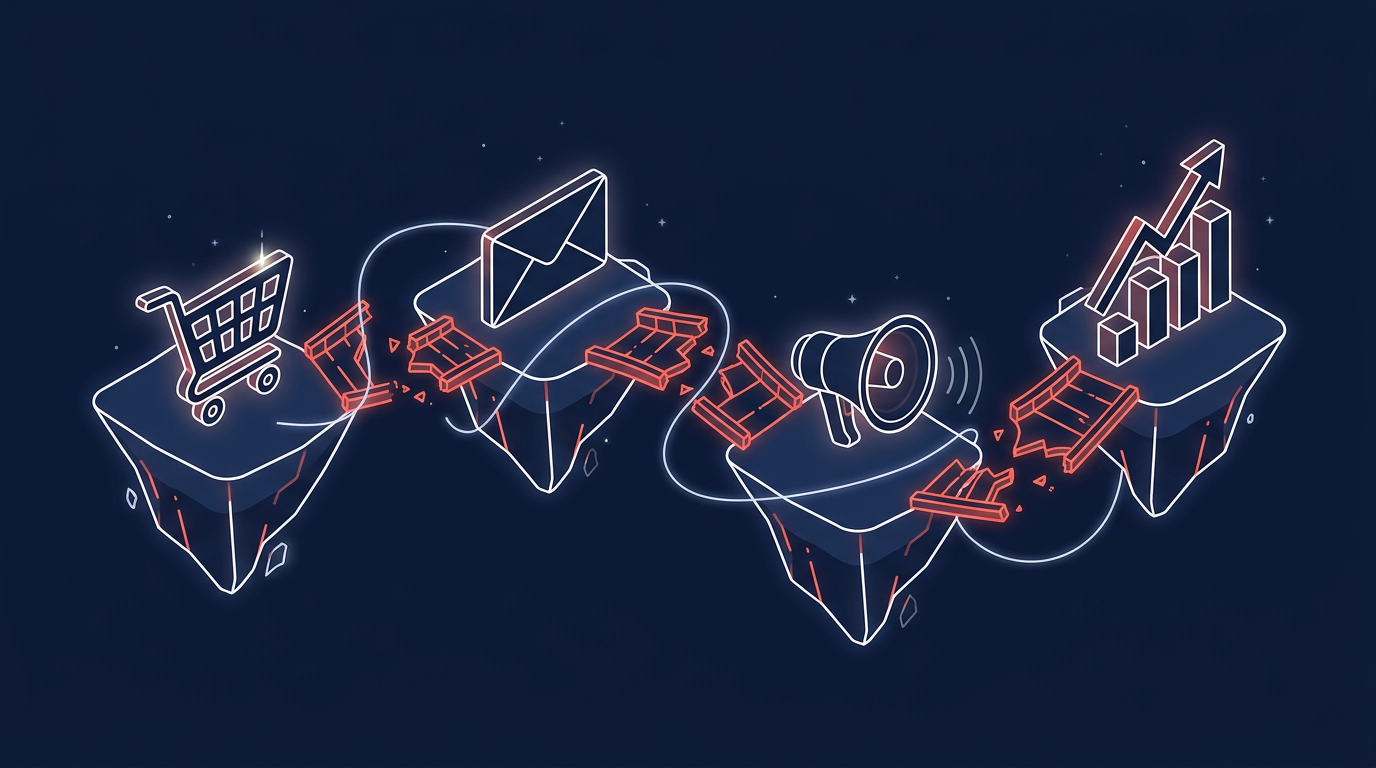
Every DTC brand I audit has the same stack: Shopify, Klaviyo, Meta, maybe Google. Solid tools. The problem is never the tools. The problem is that they're operating in complete isolation.
Nobody is connecting the dots.
What Disconnected Looks Like in Practice
Here's a scenario I see constantly. A brand runs a Meta campaign with a reported 4x ROAS. The marketing team is thrilled. But when you look at the Klaviyo data, email revenue dropped during the same period. What happened? The Meta campaign was retargeting people who were already in a Klaviyo flow and about to buy anyway. The "incremental" revenue was largely cannibalised email revenue dressed up in a Meta attribution wrapper.
Nobody caught it because nobody was looking at both systems at once.
Another one: a brand's post-purchase email flow treats every new customer identically. Whether they came from a high-intent Google Shopping search or a broad awareness campaign on Instagram, they get the same welcome series. The customer who searched "buy [product name]" and the one who saw a Story ad have fundamentally different relationships with the brand. Treating them the same wastes the most valuable moment in the customer journey.
The Hidden Costs
The obvious cost is wasted spend: running campaigns that cannibalise other channels. But the subtler costs are worse.
Speed. When insights require pulling data from four platforms and manually correlating it, decisions take days instead of hours. By the time you've assembled the picture, the moment has passed.
Misallocation. Without unified data, budget decisions are based on platform-reported metrics that each tell a self-serving story. Meta says Meta is working. Google says Google is working. Klaviyo says Klaviyo is working. The brand doesn't actually know what's working.
Context loss. Every time information passes from one team or tool to another, nuance gets stripped out. The insight that drives a good decision rarely survives three handoffs.
What an Integrated Stack Actually Looks Like
It's not about consolidating everything into one tool. It's about having one person, or one system, that reads across all of them and makes decisions with the full picture.
That means your ad strategy accounts for email revenue. Your email flows are segmented by acquisition source. Your Shopify data informs your bidding strategy. Your creative performance data feeds back into product decisions.
When the stack is connected, every decision gets better. Not because the tools improved, but because someone is finally reading all the signals at once.